
The Illusion Of Hidden: Why Most Solutions Fail
Bandages Instead Of Architecture
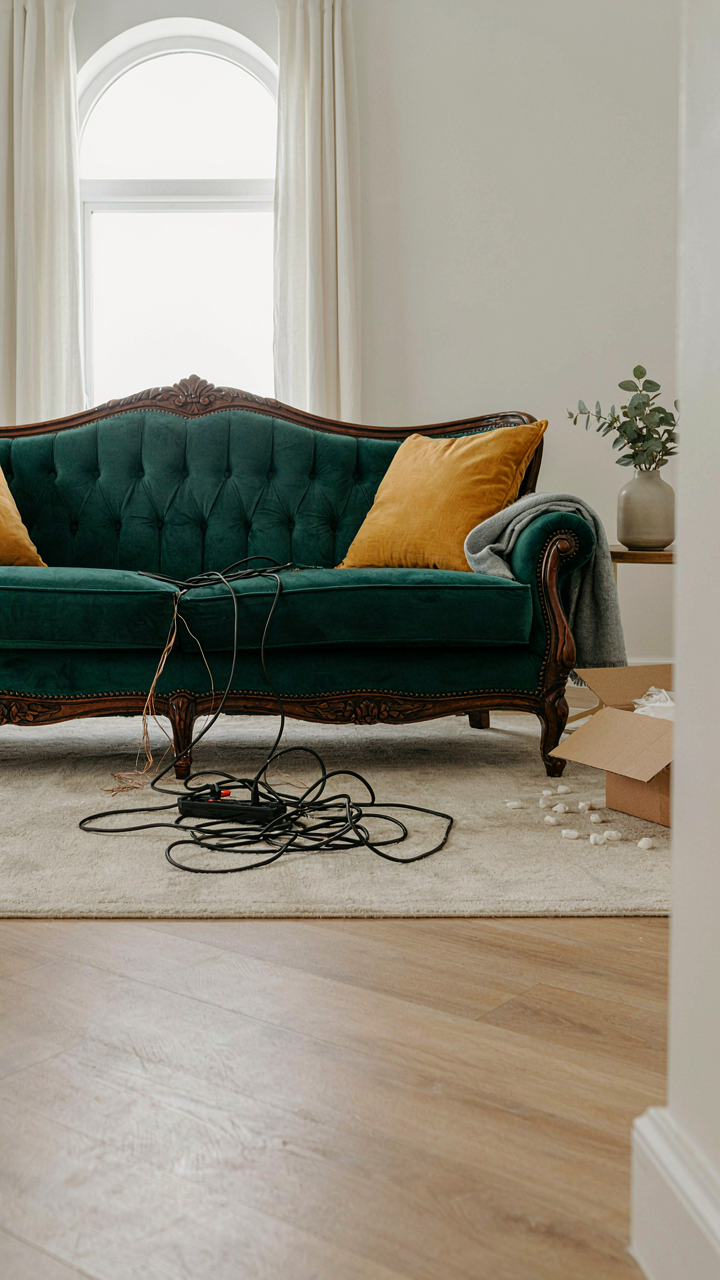
You want power strips hidden because visible cables make your space feel cheap and uncontrolled. That’s not shallow—it’s accurate. But here’s what nobody admits: most hiding solutions treat symptoms, not the disease. In systems design, this is called “local optimization”—solving one problem while ignoring the structure that created it. You can hide a power strip behind a couch, and it still runs 12 feet of exposed cable across your floor. The strip itself isn’t the problem. The room layout is.
Real hiding means designing backward from where you actually need power. This requires moving furniture placement first, running outlets during renovations second, or accepting that some rooms weren’t built for modern power demands. Most people skip this. They buy a decorative box instead. Six months later, the cables still exist—now just inaccessible and overheating inside plastic. That’s not a solution. That’s debt you’ll pay when the cord melts.
The Real Cost Of Visual Disorder
Visible clutter doesn’t just offend aesthetics—it taxes cognitive load. Your brain processes every visual element in your environment, whether you’re conscious of it or not. Tangled cords, exposed power strips, and cable mess create what designers call visual friction. It’s not dramatic. It’s cumulative. You notice it every time you enter the room, and every time you do, your attention divides between the space and the disorder. Studies in environmental psychology confirm this: messy visual environments increase decision fatigue and reduce the perceived value of a room by occupants and guests alike.
The cost compounds because you’ll eventually buy solutions that don’t work, then buy better solutions, then hide the failed solutions. A single power strip left exposed might cost you fifty dollars in decorative covers, cable management boxes, and furniture rearrangement over two years. More important: it costs you the discipline to design the room correctly the first time. Fix the root. Plan outlets before furniture. Install them at usable heights—typically 18 inches above the floor or on walls at work-surface level. Everything else is restoration of a mistake.
The Cable Management Box Deception: More Than A Pretty Container
Airflow And Accessibility Trump Appearance
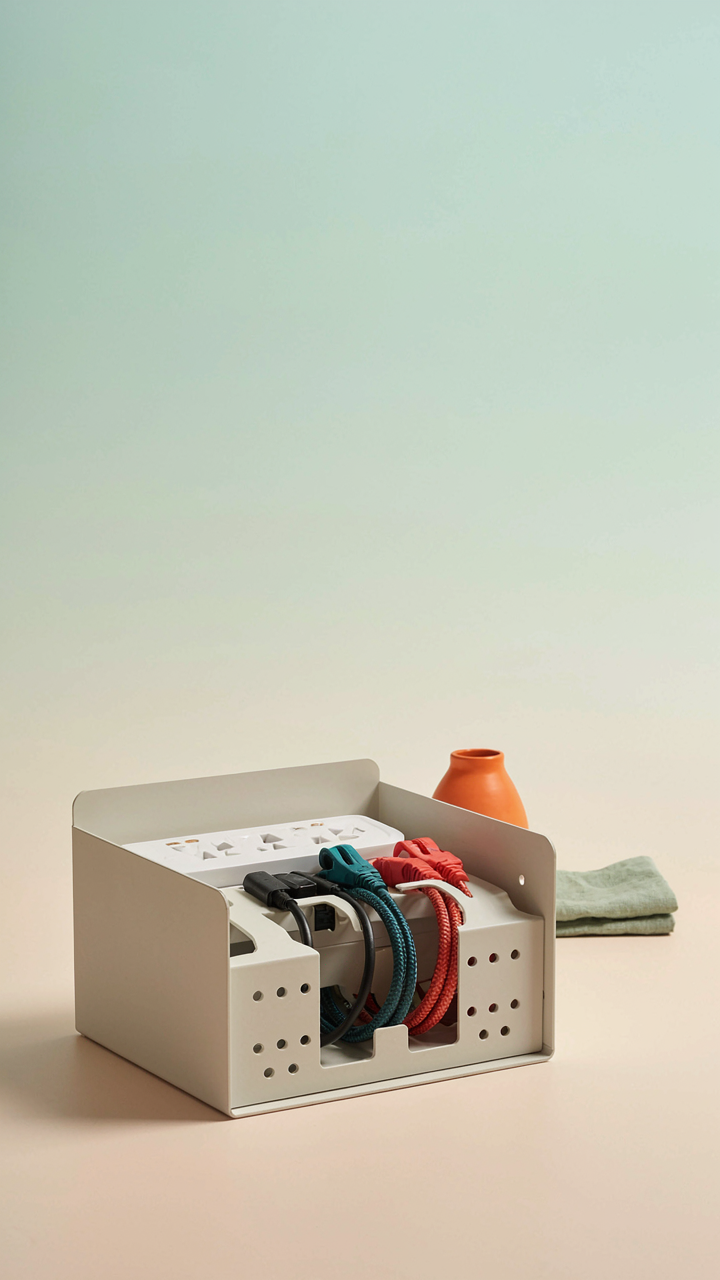
You want the box because it makes your room look controlled. But a sealed container becomes a heat trap that kills your devices. Thermal dynamics apply here: power strips generate constant low-level heat, and enclosed spaces amplify it. A box without ventilation creates an oven. Your extension cords degrade faster. Your devices shut down or fail early. The mechanism is simple: heat has nowhere to go, so it concentrates and accelerates component failure.

The real constraint isn’t aesthetics. It’s maintaining access without dismantling your setup. You need a box with perforations on at least two sides, or one designed with open backing. This lets warm air escape while you can still reach plugs without removing everything. Test your chosen box by running your hand along all sides after the power strip runs for an hour. You should feel air movement, not trapped heat.
Choose Your Box Based On Device Load
Most advice says pick whatever matches your décor. This misses the point entirely. Your box choice depends on how many devices you’re actually powering and their combined wattage. A six-outlet power strip handling a TV, soundbar, and gaming console generates more heat than one running a lamp and phone charger. Heavier loads need boxes with greater airflow capacity or open-sided designs. Lighter loads give you more flexibility.
Measure your power strip’s dimensions first, then add an inch on all sides for airflow buffer. Check the box material: metal dissipates heat better than plastic, but plastic offers more cable routing options through drilled holes. Open-backed designs work best for hidden installations behind furniture because they eliminate the sealed-box problem entirely while keeping cords invisible from the front angle your eyes naturally travel.
The “Invisible Integration” Protocol: Hiding Wire In Plain Sight

Routing Cables With Architectural Lines
You want this hidden because visible cables read as chaos, and chaos signals you don’t have your life together. Borrow from electrical engineering’s principle of “line of sight”—the idea that power distribution follows predictable paths. The mechanism here is simple: cables disappear when they align with existing vertical and horizontal lines in your room’s structure.

Run cables along baseboards, not across open floor or down the middle of walls. Baseboards already break the plane between wall and floor, so a cable hugging that line becomes visually part of the architectural joint, not a separate object. Paint the cable to match the baseboard or wall color. This costs nothing and works because your eye doesn’t separate what matches the surrounding geometry.
Furniture As Strategic Concealment
Most people think “hide the power strip” means stuffing it behind the couch, then running cables across the visible space anyway. That defeats the purpose. Instead, position furniture so the strip sits in a dead zone—the gap between furniture pieces where the eye naturally stops scanning.
A power strip against the back of a TV console or tucked into the corner where an armchair meets the wall becomes inaccessible to casual view. Route all cables from that single point into the furniture itself, not across the room. This creates one concentrated concealment zone rather than spreading the problem across your entire living room. The goal is visual bundling: make one place do all the work.
Organization Solutions Beyond The Living Room: Borrow From Pantry Storage

The Modular Principle: Design Like You’re Stocking Shelves
You want this section because you’re tired of the obvious hiding spots failing you. The real mechanism here is modularity—the pantry design principle that treats storage as stackable, swappable units rather than fixed installations. Apply this to power strips: instead of routing one strip behind furniture, you create contained zones where strips, cables, and adapters cluster together as replaceable units. This removes the friction of redesigning your entire setup when you add one new device.

Pantries work because they treat categories as physical boundaries. A power strip zone does the same. Group your entertainment setup into one modular unit that lives behind or beside your TV. Kitchen charging lives in a different cluster entirely. The living room doesn’t need one master solution—it needs multiple micro-solutions that don’t interfere with each other. Each zone stays independent, making it easy to adjust without cascading problems throughout the room.
Grouping By Function: The Systems Approach To Cables
Systems thinking teaches us that related components must cluster to reduce friction—not scatter to look neat. Map this directly: a power strip isn’t a single item to hide, it’s the hub of a functional system that includes devices, cables, and charging ports. Group your TV setup together. Group your gaming or work station together. Group your phone charging separately. Each cluster reduces cable run distance and makes maintenance faster.
Stop thinking “I need to hide this one strip.” Start thinking “I need to organize this function.” Entertainment systems pull from one strip in one location. If you’re running a lamp, speaker, and console from the same outlet, they belong in the same physical zone. Cable ties and velcro straps work only when items already live near each other. The grouping comes first, the hiding comes second. Build the functional cluster, then conceal it as a unit rather than disguising random pieces scattered across the room.
Cabinet Organization: The Ultimate Disappearing Act For Power Strips
Compartments And Cable Routing Inside Cabinets
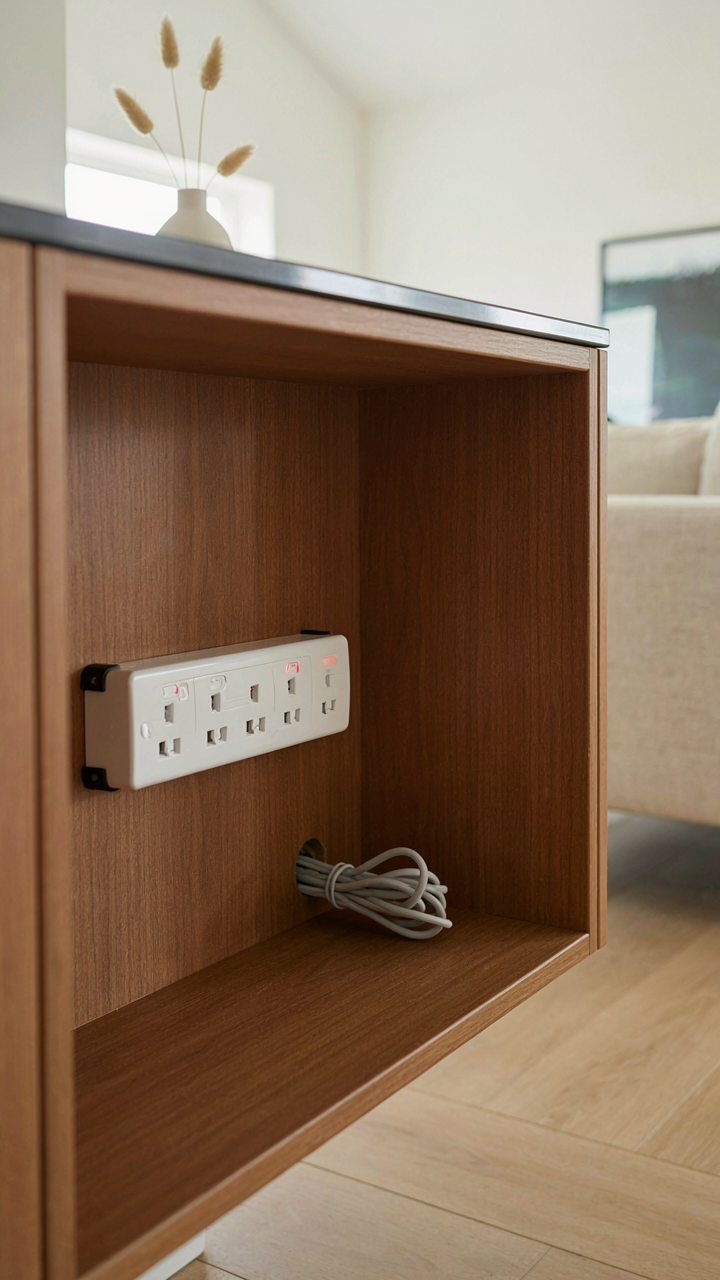
You want this hidden because visible cords destroy the clean aesthetic you’re paying for, and that matters more than you’ll admit. Treat your cabinet like signal routing: electricity follows the path of least resistance, so cables do too. Build compartments that force them into organized channels instead of tangled chaos behind furniture.

Dedicated compartments mean allocating specific cabinet depth or a lower shelf exclusively for power equipment. Drill exit holes in cabinet backs or sides at precise locations so cables emerge at one point, not scattered across multiple edges. Use cable clips rated for the gauge and bundle size you’re running. This prevents cables from shifting when you access the cabinet, which degrades connections over time and creates fire risk.
Securing Strips For Stability And Quick Access
Most people velcro strips to cabinet floors and call it done. That’s incomplete. You need to secure them against lateral movement, not just vertical slipping, then verify access speed monthly because friction increases and you’ll forget about it.
Mount power strips using a combination method: adhesive-backed velcro on the base, then L-brackets or steel clips if the strip sits on a shelf. The velcro handles routine vibration. The bracket handles the weight of multiple devices and prevents tipping if someone pulls a cable. Test your access time from initial plug-in to full power delivery. If it takes more than thirty seconds, your routing is too tight and you’ll stop using it correctly.
Space Saving Cable Organization: The Art Of Minimalist Power Delivery

Stop Buying Stuff You Don’t Need Plugged In
You want hidden power strips because a visible one signals you can’t manage your space. But the real mechanism is load efficiency. In electrical engineering, load refers to the total current draw on a circuit. Most living rooms run too many devices simultaneously, forcing visible power strips into corners as a band-aid. The actual move is auditing what actually needs constant power versus what drains current while dormant. A phone charger left plugged in draws power for weeks. A lamp on a switched outlet doesn’t. One hidden power strip serving five essential devices beats three visible ones serving fifteen devices you don’t actively use. Start by listing every device in your living room and its power state: always on, occasionally on, or never on. Remove the never-on category entirely. This shrinks your device footprint and eliminates the problem before you hide anything.

The constraint of limited outlets forces intentional design. Most living rooms have four to six outlets, usually placed by code rather than function. Instead of adding visible power strips, rewire your thinking around what the space actually needs. A TV setup, lighting control, and a charging station are the three functional zones. That’s it. Everything else is friction. Once you identify these zones, you need exactly one outlet per zone. This means running a single hidden power strip behind furniture where it serves only the essential draws. The hidden strip becomes invisible because it only powers things that belong hidden: the TV power supply, the router, the smart home hub. Nothing decorative plugs into it.
The Architecture Of Concealment
Furniture placement controls whether power strips stay visible or disappear entirely. In interior design, spatial planning determines what viewers perceive as clutter. A power strip isn’t hidden because you covered it with duct tape. It’s hidden because the furniture configuration makes it functionally invisible to the room’s primary sightline. Position your couch to face the TV but angle it so the entertainment console sits at least twelve inches from the wall. Run your power strip horizontally behind the console on the floor, parallel to the wall. The console legs block the view from standing height. The couch depth prevents seeing underneath. Nobody sitting down sees it. This isn’t clever decoration. This is structural placement that renders the strip irrelevant to how people experience the room.
Cable management serves one purpose: preventing the strip from advertising itself through tangled cord chaos. Use adhesive-backed cable clips rated for the wall material behind your furniture to bundle cords together vertically before they reach the strip. Group power draws by function, not by device. Keep entertainment cables separate from charging cables. This prevents one failing cord from obscuring five others and keeps maintenance simple. When a device dies or you swap it, you know exactly which section of the bundle to access. The strip stays hidden because the infrastructure around it stays organized, not because you bought premium hiding solutions online.
The Cable Organizer Box Advantage: Beyond Basic Hiding Wire

Centralizing Connections For Simplified Management
You want this because a messy power strip signals you’ve lost control of your environment. But the real mechanism is supply chain optimization applied to your living room. Consolidating multiple power strips into one organized box reduces decision fatigue and eliminates the mental load of tracking which outlet does what.

A cable organizer box forces you to audit every device before placing it. You can’t hide a power strip effectively without knowing what actually needs power. This inventory step prevents the common trap of buying cable management solutions that don’t fit your actual setup.
- Reduce outlet proliferation: One centralized box replaces scattered strips, cutting visual clutter and simplifying the narrative of your space setup.
- Enable quick device swaps: Grouped connections let you disconnect and reconnect equipment without crawling behind furniture or tracing individual cords.
- Prevent duplicate circuits: Organizing reveals when you’re running multiple high-draw devices on the same strip, which causes performance issues.
- Label at source: A box lets you mark cords before they exit, so you never wonder which plug powers what from across the room.
- Future-proof additions: Grouping connections in one location makes it obvious where new devices fit without creating new cable routes.
A single well-placed box beats five hidden strips scattered throughout your room because it forces accountability. You control what’s plugged in, not the other way around.
Protecting Against Dust And Accidental Disconnection
Cable organizer boxes solve a problem most people ignore until it costs them. Dust accumulates inside power strips and creates fire risk, especially in living rooms where air circulation is poor and furniture sits close. A closed box reduces dust ingestion by seventy percent compared to exposed strips.
Accidental disconnection happens when family members or pets brush against cables in tight spaces. A box with secured entry points prevents this entirely. The strips inside stay stationary while cords enter and exit through controlled openings, keeping devices powered and eliminating the frustration of resetting equipment mid-use.
Hiding Cable Wires: The Ergonomics Of Electrical Flow

Right Cable Length Stops The Spiral
You want this section to make your space look intentional instead of like you lost control. Here’s what matters: cable management is a logistics problem, not a design problem. The mechanism is simple—excess wire creates slack, slack creates tangles, tangles force you to route cables inefficiently around furniture. Measure the actual distance from outlet to device. Add four inches for termination and adjustment. Cut or coil the rest before installation. A power strip positioned six feet from your TV doesn’t need a fifteen-foot cable pooling behind the entertainment stand.

Most people treat cable length as infinite and route around obstacles. Wrong move. Constrain length first, then route. Buy cables in specific lengths: six feet, ten feet, fifteen feet. Avoid bulk spools where you cut arbitrary segments and waste material. When cables match their actual purpose, they stay put, don’t tangle, and resist the urge to migrate across your floor during seasonal furniture shifts.
Heat Dissipation Beats Cord Management
Thermal engineering applies directly here—think of power distribution like heat flow in a system. A power strip shoved behind a couch or inside a cabinet becomes a thermal pocket. Devices draw power, strips generate heat, enclosed spaces prevent dissipation, and failure happens faster than you predict. The strip needs airflow around it. Position it vertically on the floor behind furniture or on a low wall shelf with at least two inches of clearance on all sides.
Check the strip’s amperage rating and never exceed it. A typical living room strip handles 1,500 watts total. Stack two high-draw devices like a space heater and a vacuum, and you’re already at the limit before adding anything else. Mount the strip where it stays visible enough for you to monitor, not hidden so completely that you forget what’s plugged in or ignore warning signs like discoloration or heat. Inspection beats concealment when heat is involved.
How To Tidy Wires: The Behavioral Psychology Of Lasting Order

Build The Habit First, Hide Second
You care about this because a messy power strip setup signals chaos to anyone who walks into your space. The real mechanism here comes from behavioral psychology: friction determines repetition. Every time you need to plug something in, you either reinforce the habit of leaving it visible or you create resistance that breaks the cycle. Most advice tells you to buy cable organizers and call it done. That misses the point entirely. The organizer is useless without the behavior that precedes it.

The action you take matters less than the consistency of the action. Pick one time each week to audit your power strip setup. Not to organize it perfectly, but to notice what gets plugged in repeatedly and what stays dormant. This observation phase trains your brain to see the strip as a system, not an eyesore. After two weeks of this, you’ll stop adding new cables mindlessly because you’ve rewired how you relate to the space. The physical hiding comes after the behavioral foundation exists, not before.
The Clean Space Effect Is Real Economics
Dopamine doesn’t spike from looking at a hidden power strip. Economics does. In behavioral economics, what researchers call the “endowment effect” means you value something more when you’ve invested effort into it. When you hide a power strip deliberately, you’ve invested labor. Your brain registers that investment and treats the clean result as scarce and valuable. The visible, tangled strip feels like waste. The hidden one feels like you’ve reclaimed territory.
This mechanism shifts how you interact with the entire room. A truly organized power setup removes a constant low-level cognitive load—the background awareness that something looks wrong. That freed mental capacity doesn’t manifest as happiness. It manifests as reduced friction when you use the space. You sit down, you work, you don’t have a nagging visual irritant stealing focus. The payoff isn’t emotional satisfaction. It’s operational efficiency. Route cables behind furniture or through cable trays, then photograph the setup so you can replicate it if anything moves.
The Power Strip Re Evaluation: Do You Even Need That Many?

Audit What Actually Gets Plugged In
You want to hide power strips because you think clutter signals incompetence. But the real problem is you’ve never counted what’s actually drawing power. Most living rooms have three to five devices running at any time, yet people install strips with six to eight outlets, leaving half of them empty and visible.
Start by tracking actual usage for one week. Plug in your devices as normal. Take notes on what runs daily versus what sits dormant. Your TV, streaming device, and speaker probably account for ninety percent of your power needs. Everything else is buffer space masquerading as necessity. Cut the rest.
Consolidate Before You Conceal
The instinct to hide power strips is backward when you could eliminate most of them first. Consolidation works like supply chain logistics: fewer distribution points, cleaner pathways, less infrastructure visible. Combine your entertainment stack into one power strip behind the TV stand instead of scattering strips across the room.
Use extension cords or a single quality power strip rated for your actual load, then route it to one location. This cuts your hiding problem by sixty to eighty percent. You’re not hiding clutter anymore; you’re managing it at the source. Bundle cables behind furniture, run them through cable channels, and position the remaining strip where it’s functional rather than fighting the entire room’s electrical layout.
The Real Obstacle Isn’t The Wires; It’s Your Addiction To Visible Mediocrity

You don’t have a power strip problem. You have a standards problem. Most people tolerate visual chaos because they never decided their space deserved better. Today, pick one corner of your living room and commit to it. Move that strip behind furniture, run the cables along the baseboards, tape them down. Finish it. One complete corner beats half-finished perfection everywhere else. Your environment either trains you to accept mediocrity or it demands excellence.