
The Minimalist Mandate: Why Less Is Always More

What Actually Matters On Your Desk
You want a setup that looks competent because you’re afraid a cluttered bench signals incompetence. That’s backwards. The real mechanism is constraint: forced limits on what you own force you to get good with what you have. Every extra tool you buy delays mastery of the core ones.
A soldering station needs three non-negotiable elements. A heat source that reaches temperature fast and holds it stable. A way to hold the work steady while both your hands stay free. A method to clean the tip between joints. Everything else is performance theater. Most people buy the fourth, fifth, and sixth tool before they’ve actually used the first three correctly.
What To Leave Behind
The common advice says buy a complete station kit with a desoldering pump, wire holder, brass wool, digital display, and articulating arms. Ignore this. These kits prey on decision paralysis, not on what small desks actually need.
Start by rejecting any tool that duplicates function. A brass wool cleaner and a wet sponge both clean tips, so pick one. A third hand with alligator clips and a helping hand tool do the same job. An iron holder and a stand serve identical purposes. The desoldering pump seems essential until you realize it fails regularly and costs money each time it does. Master the wick first. When your desk has three square feet, you choose: the pump or the space. You choose space.
Deconstructing “Small Desk”: Your Hidden Advantage

The Real Cost Of Infinite Space
You’re worried a small desk means you’ll outgrow your setup and waste money. Here’s what actually happens: constraint forces prioritization, and prioritization kills waste. In economics, the scarcity principle states that limited resources force allocation decisions that reveal true value. Apply this to soldering stations and you stop buying tools you’ll never touch. A small desk becomes your filter.

The common advice is “start small and upgrade later.” That’s incomplete. Upgrading later means buying twice, learning twice, and admitting your first choice was wrong. A small desk forces you to buy what you’ll actually use in five years on your first purchase. This is not deprivation. This is clarity.
Constraints That Build Better Workflows
Physical limits reshape how you work, and most people miss the mechanism entirely. When your desk measures thirty-six inches wide, you cannot sprawl. You cannot hide bad tool placement behind abundance. You stack vertically, you zone by function, you know exactly where every item lives. This is the opposite of hobbyist chaos.
The setup that works on a small desk works everywhere. Pad it to a larger surface and you maintain efficiency. Reverse the process and you scramble. Build tight first. Your soldering iron sits within six inches of your solder spool, your wet sponge, and your work vise. Your multimeter and helping hands occupy the second tier. Your component trays hang above. That spatial logic transfers directly when you scale up later.
The Spartan Soldering Station: Essential Gear Only

Why The Atten Station Wins On Restraint
You want the expensive setup to justify itself, so you’re scanning for features. Stop. The real mechanism here is constraint: Atten soldering stations force you to work within limits that actually sharpen your technique instead of letting sloppy habits hide behind dial options. The Atten 937D or 939D series locks you into core functionality. Temperature control works. The iron heats fast. The stand holds steady. No unnecessary complexity bloats your desk or your learning curve.

The Atten platform separates signal from noise by design. You get a single adjustable dial, not ten nested menus. This means faster warm-up, fewer moving parts to fail, and zero time wasted hunting settings. Desktop real estate stays open because the footprint stays small. The iron itself uses a standard tip cartridge system, which means replacements cost pennies and you’re never chasing proprietary parts. That’s the actual value: a tool that works without demanding attention.
Compact Features That Refuse To Waste Space
Workspace economy is pure logistics: every inch of your desk has a carrying cost. A proper soldering station compresses function by stacking the sponge holder and tip cleaner into one unit at the iron’s rest point, eliminating a separate container. The wet sponge sits directly below where you park the iron, so you grab and clean in one motion. Brass wire cleaner coils take up almost no room and outlast sponges by months. Your fume extraction hose routes behind the station rather than across it, keeping the work area clear.
The power cord management determines whether your desk looks operational or chaotic. Run the cord vertically down the back leg, then horizontally along the desk edge using adhesive clips. This single protocol removes visual clutter and prevents the iron from yanking the station when you move. Temperature accuracy stays tight because you’re not dragging the station around. Cable management isn’t decorative: it’s the difference between a tool you’ll actually use daily and one that creates friction every session.
The “Nonentity” System: Invisible Workflow, Visible Results
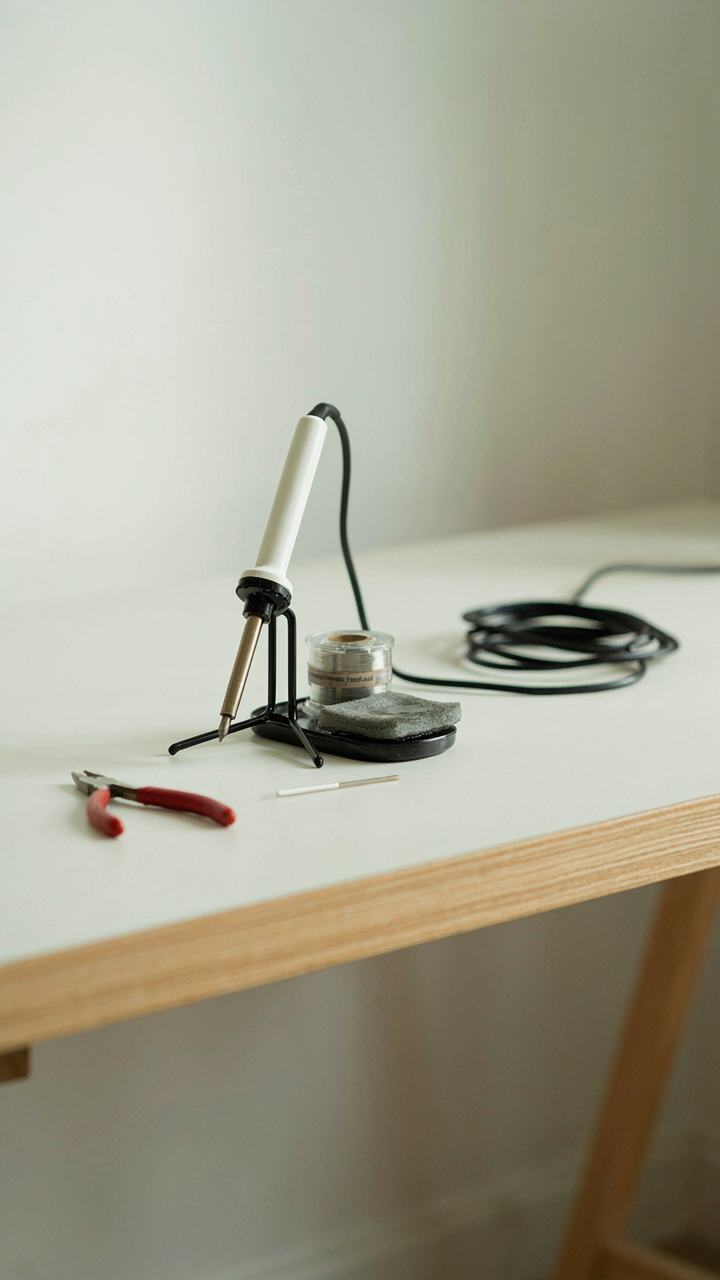
When Your Station Disappears Into Function
You want your setup to look intentional, not cluttered—that’s the real fear here. A messy station signals incompetence, even if your joints are solid. The mechanism is simple: constraint forces efficiency. When you design for a small desk, you eliminate waste by default. Every component earns its place. This is the opposite of the “more tools = more professional” myth that keeps beginners buying gear they’ll never touch. A tight station forces you to move in sequence, not scatter. Movement becomes invisible because it’s predetermined.

The Bauhaus principle applies here: form follows function. Eliminate visual noise, and workflow emerges naturally. Your solder spool sits next to your iron because that’s the order you use them—not because it looks clean. Your wet sponge or brass wire cleaner positions itself within arm’s reach of the iron tip, not on the other side of your desk. Every micro-decision compounds. After two weeks, your hands know the route without thinking. That’s when a station becomes nonentity—it stops being noticed because it works.
Cable Routing That Nobody Sees
Most people coil cables loosely and call it done. Wrong. Cable routing is load distribution. When you manage cable stress, you eliminate the hidden damage that kills components years later. Your iron cord should never bend sharply near the handle. That’s where insulation cracks start. Route it up and away from your work surface using a clip or adhesive guide. Your solder sucker, if you use one, has a cord that catches on everything—secure it to the underside of your desk with a simple adhesive-backed holder, not on top where it becomes an obstacle.
Every cable should follow the perimeter of your desk, not cross the work zone. This means measuring your cord lengths before you buy. An iron cord that’s too long creates loops; too short creates tension. Twenty-four to thirty inches is standard for a small desk station. Your wet sponge holder connects to a power outlet behind your desk, not in front. Your fume extractor—if you have one—sits to the side with its intake cord running along the back edge. The goal is this: you should never see a cable when you’re working. If you see it, it’s in the wrong place.
Vertical Victory: The Overlooked Dimension
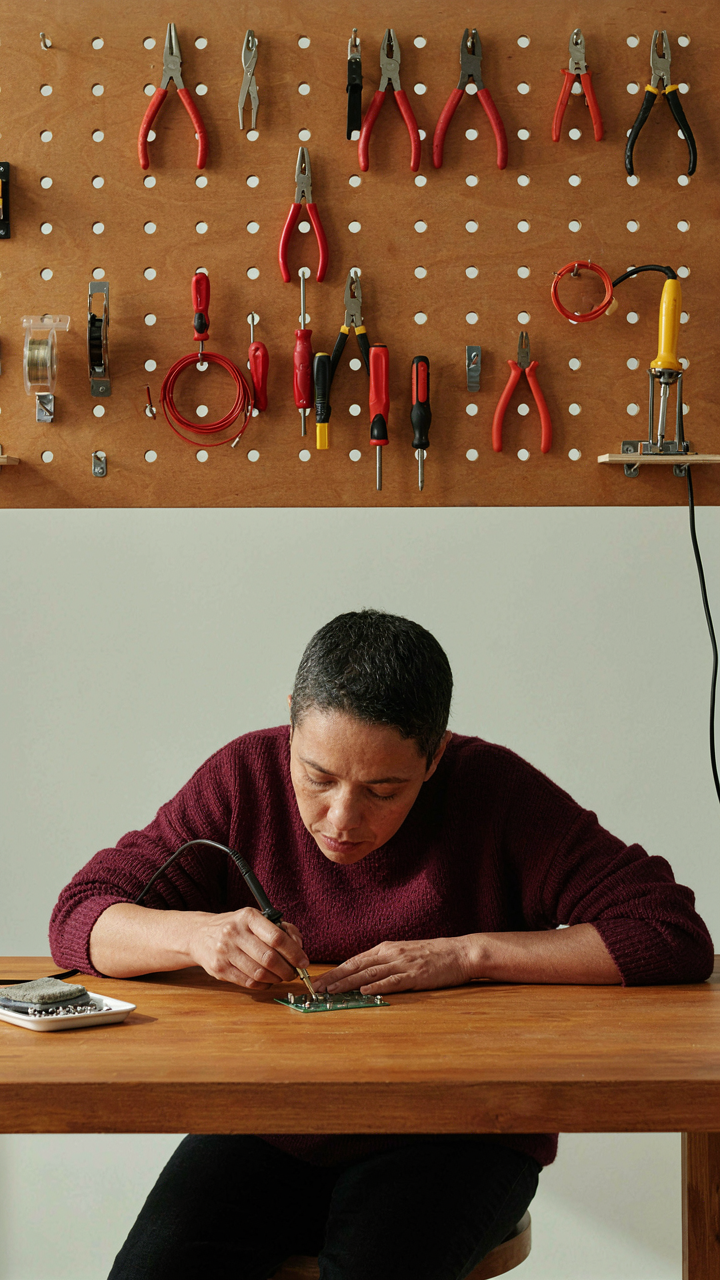
Going Up Instead Of Out
You want to believe your desk is too small for a real soldering station, but the truth is you’re afraid of looking cramped. Here’s the mechanism: most people treat their work surface as a single plane when it’s actually a three-dimensional volume they’re wasting. In architecture and industrial design, this is called vertical stacking—the practice of maximizing Z-axis space when X and Y are constrained. Your soldering iron, solder spool, flux pen, and helping hands don’t need desk real estate. They need elevation.

A pegboard mounted twelve inches above your work surface or a wall-mounted shelf bracket holding a thin tool organizer removes your most-used items from your working plane entirely. The iron sits in its stand on an upper shelf. The solder reel clips to a vertical holder. Your wet sponge or brass wire cleaner occupies a small tray at arm height, not elbow height. This isn’t organization theater. It’s reclaiming your actual soldering space while keeping everything within one arm’s reach. The work stays uncluttered. Your hands move less. Your throughput increases.
Shelving That Scales With Your Work
Most small-space advice tells you to “get creative with storage,” which is useless because it skips the actual constraint you face. The constraint isn’t lack of shelves. It’s that your station needs to transform from “unused corner” to “active workspace” in seconds, then collapse back without friction. Modular shelving systems—the kind using adjustable brackets and interchangeable shelf depths—let you configure exactly what you need for your current project without overbuilding.
Start with two or three brackets mounted to the wall behind or beside your desk. Use shallow shelves, six to eight inches deep. One holds your iron and stand. One holds spools and materials. One holds finished boards or test components. The entire system costs less than thirty dollars and mounts with four screws. When you’re not soldering, nothing blocks your sightline. When you start a session, every tool is at eye level, positioned for grab-and-place efficiency rather than dig-through-a-drawer friction. The mechanism is simple: constraint drives configuration, configuration drives speed.
The Bio Ergonomic Loop: Workflow As A Feedback System

Mapping Movement Patterns Onto Physical Space
You want this to feel effortless so you’ll actually use it instead of abandoning the hobby after two months. The real mechanism here is cybernetics: a system that self-corrects based on feedback loops. Your soldering station setup is a feedback loop. Every reach, every pivot, every second spent searching for a tool either reinforces good behavior or punishes it until you quit.

Most people treat desk layout like a static problem: put the iron here, put the solder there, done. Wrong. Your hands will naturally optimize for the path of least resistance. If your brass wire cleaner sits behind your iron instead of beside it, you’ll unconsciously skip cleaning between joints. That skipped step compounds into cold solder joints. Map your workflow backwards from the actual solder joint. Everything your hands touch in sequence should exist in that sequence on your desk, left to right or in a tight cluster. Test this for three days. Your hands will tell you what works because they vote with motion.
Identifying And Removing Hidden Friction
The common advice says “organize everything in sight” which creates visual clutter and decision fatigue. The real friction isn’t visible. It’s the micro pause before each action. You reach for your solder spool and your hand hesitates because the stand wobbles. You pick up your desoldering wick and need to unwrap it from a tangled bundle. You grab your iron and it’s still cooling from the last joint. These aren’t inconveniences, they’re friction points that stack into workflow failure.
Friction lives in three places on a small desk: transition time between tools, tool accessibility during the active joint, and thermal or mechanical readiness of equipment. Redesign around these. Mount your solder spool on a weighted base that doesn’t move. Pre-cut and organize desoldering wick in a dispenser, not loose. Position your iron on a stand that keeps it at hand height, not dangling at an angle. Run your station through ten complete solder joints. Time each one. Redesign the layout of the weakest points. Repeat for three sessions. The workflow that emerges isn’t optimized for beauty, it’s optimized for repeatability.
Power Grid Protocol: Smart Energy For Tight Spaces

One Outlet Does The Work Of Three
You want to avoid the conversation with your landlord or spouse about drilling new circuits into the wall. That’s the real constraint here. Thermodynamic systems teach us about load distribution—in soldering, your iron, fume extractor, and task lighting all compete for the same thermal and electrical budget on a small desk. One quality power strip with surge protection rated for at least 15 amps handles all three without creating a fire hazard or voltage sag that degrades iron performance.

Daisy chaining power strips kills the whole point. Buy a single heavy-gauge strip with individual on/off switches for each outlet—this gives you granular control without rewiring. Mount it vertically on the desk side rail or wall behind your station using adhesive clips. This keeps cables organized, prevents accidental unplugging, and saves surface real estate. Your iron gets a dedicated outlet; your fume extractor gets its own switch to kill it between sessions.
Kill The Phantom Load Between Sessions
Most people leave everything plugged in and powered on because unplugging feels like friction. It’s not. A soldering iron left on for eight hours wastes energy and shortens heating element life—the coil degrades faster under sustained heat. Unplug your iron immediately after use. Your fume extractor should have a separate switch; flip it off the moment you finish your last joint.
The thermal load matters on a small desk because every watt of heat radiates into your work area. Less active equipment means lower ambient temperature, which keeps your solder joints cleaner and your hands less fatigued. Turn off your task lighting if you step away for more than five minutes. This is not about saving money on your electric bill—it’s about reducing the chaos your station creates in a confined space and extending your equipment’s working life. Switch everything off when you stop soldering.
The “How To Set Up” Fallacy: It’s About How You Optimize

Setup Is A Myth Without Maintenance
You’re reading this because you want to feel like you’ve solved the problem once and move on. You haven’t. Most people treat soldering station setup like interior design: arrange it, photograph it, forget it. That’s inventory thinking. Think in terms of thermodynamic decay instead. Your station degrades the moment you stop adjusting it. Temperature calibration drifts. Solder flux residue hardens on tips. Wire insulation material changes batch to batch. The real work starts after assembly.

The gap between a functional station and an optimized one isn’t hardware. It’s protocol. You need a feedback loop. Track solder joint quality month to month. Note when your iron loses heat retention. Write down which flux type leaves the least cleanup burden. Most people skip this because it feels tedious. That’s precisely why it works. Tedium eliminates guesswork and reveals actual failure points before they tank your work.
Consumables Decay Faster Than You Think
Your supplies have expiration windows that don’t print on the packaging. Solder paste oxidizes even sealed in a container, especially if your desk sits in direct sunlight or temperature fluctuates between seasons. Flux loses potency after twelve months of exposure to air. Tip cleaners degrade when they dry out from inconsistent use patterns. Desoldering braid absorbs moisture and loses capillary action over time. Most people replace these reactively, meaning they discover the problem mid-joint when precision matters most.
- Solder wire and paste: Check oxidation levels quarterly. Replace if surface shows dull gray instead of shiny finish. Store in cool, dry conditions away from humidity swings.
- Flux pen or liquid: Replace every twelve months regardless of appearance. Old flux produces cold solder joints even when your iron temperature reads correct on the display.
- Desoldering braid and solder sucker: Inspect the braid texture monthly. Replace when fibers clump or feel stiff instead of flexible and absorbent.
- Cleaning sponge or brass wire cleaner: Brass cleaner lasts longer than sponges. Rotate out sponges every eight weeks or when they no longer restore tip shine in one wipe.
- Iron tips: Track when your tip starts rejecting solder or heating unevenly. Replace every three to six months depending on usage volume and iron temperature settings.
Build a quarterly audit habit. Spend fifteen minutes inspecting every consumable against a written standard. Document what you find. This prevents the slow decay that makes you blame your technique when the problem lives in your supplies. Run a test joint on scrap material before switching back to real work after any consumable replacement.
The Habitual Engineer: Maintaining Peak Performance

The Five Minute Reset
You want to believe that discipline is something you summon on demand. It isn’t. You’re actually terrified that your station will decay the moment you stop paying attention, because you’ve seen it happen before. The mechanism is entropy, borrowed from thermodynamics: a system slides toward disorder unless energy is applied. Your soldering station is no different.

Spend five minutes at the end of each session. Put the iron in its holder and let it cool. Wipe the sponge or brass cleaner dry. Return solder spools to their container. Sweep flux residue into the trash. This isn’t cleaning. This is resetting the board state so tomorrow’s work starts at baseline, not in recovery mode. The compounding effect: a station that supports speed instead of fighting you.
The Acquisition Filter
Most people claim they want a minimal station, then buy random tools whenever they encounter friction. Wrong logic. Economics calls this the sunk cost fallacy, but soldering stations reveal it as pure behavioral failure: you rationalize new gear because you haven’t defined what you’re actually building.
Before you acquire anything, remove something else. A new fume extractor means the old desk lamp goes. A third-hand tool means the crooked helping hands leaves. This constraint forces you to evaluate whether the new item is genuinely better or just novel. You end up with only the tools that earned their place through comparison, not impulse. The station stays tight. Your work stays honest.
The Real Limitation Isn’t Your Desk Size; It’s Your Inability To Ruthlessly Eliminate The Non-essential

Most people fail at small desk setups because they refuse to cut. They keep the third tool they never touch. They hoard supplies in case they might need them someday. Your soldering station works because you decide what stays and what gets cut, not because you buy better containers. Strip your setup down to only what you use weekly. Everything else leaves today. Constraints don’t limit you, they force you to build something that actually works.