
The “Future Proof” Fallacy: Why New Isn’t Always Better

Planned Obsolescence Versus Real Utility
You want to feel smart about your gift choice. The mechanism you’re fighting is planned obsolescence, borrowed from industrial design: companies engineer product lifespans to force replacement cycles. A smartphone designed to slow down after two years isn’t an accident. Neither is the battery soldered permanently into a laptop. The real tell: manufacturers actively prevent repair access, not for technical reasons but to guarantee you’ll buy again.
This model works because planned obsolescence feels invisible to the gift-giver. You see a new wireless charger or the latest earbuds and assume they’re objectively better. They’re not always. Many flagship devices launched five years ago still function perfectly today. What changed isn’t capability. What changed is that the company stopped supporting the software, making the device feel dated even though it performs its core function without degradation.
Repairability And Longevity Matter More Than Specs
The common advice here is wrong: don’t chase the newest spec sheet. Repairability is the actual design signal. A device whose battery you can replace, whose screen you can service, whose parts remain available creates value that lasts. This principle applies across every gift category: cables with replaceable connectors, external batteries with standard charging ports, keyboards with individual key replacements available.
When you prioritize repairability in a tech gift, you’re not being nostalgic or cheap. You’re recognizing that a tool that lasts ten years with one repair beats a tool that lasts three years and lands in e-waste. Ask this before gifting: can the recipient or a third-party technician actually fix this thing? If the answer is no, you’re gifting planned replacement, not a tool. Choose brands that publish repair manuals and sell replacement parts publicly.
Beyond The Gadget: The “Experience Economy” Tech Basket

Subscriptions And Learning As The Real Gift
You want to look thoughtful without actually knowing what they want. That’s the mechanism here. A physical gadget forces specificity. A subscription avoids that friction entirely while positioning you as someone who invests in their growth.

Digital subscriptions and online courses work because they’re consumable rather than collectable. The recipient uses them over time, which extends your mental presence. Pairing a Skillshare membership with a Spotify upgrade or a language app like Duolingo Plus creates a gift that compounds in utility. The cost scales to any budget without looking cheap at lower price points.
The mistake most people make is buying standalone courses. A single course sits unused because it lacks momentum. Instead, stack subscriptions that reinforce each other. A coding course paired with a GitHub Pro upgrade, or a design course with Adobe Creative Cloud access, removes friction from execution and signals you understand their actual workflow.
Experiences That Replace The Screen Time Default
In behavioral economics, substitution effects measure what people stop doing when given an alternative. A gaming subscription basket doesn’t just give access to games. It replaces the default scroll-and-consume pattern with an activity that builds skill or narrative investment.
Curate around specific experience types rather than dumping random subscriptions together. A fitness tech bundle pairs a Peloton Digital membership with a meditation app like Calm. A learning bundle stacks MasterClass access with an audiobook credit from Audible. A gaming bundle includes Game Pass with a competitive game rank coaching session. Each combination removes a decision point and makes the recipient’s next action obvious.
The architecture matters more than the individual items. Bundle only experiences that feed into a single outcome. The recipient won’t mix a wellness app with a gaming subscription. They’ll pick one and ignore the other. Alignment is what converts a basket into an actionable gift stack.

The “Minimalist Tech” Protocol: Fewer, Better Things
What Actually Solves The Problem
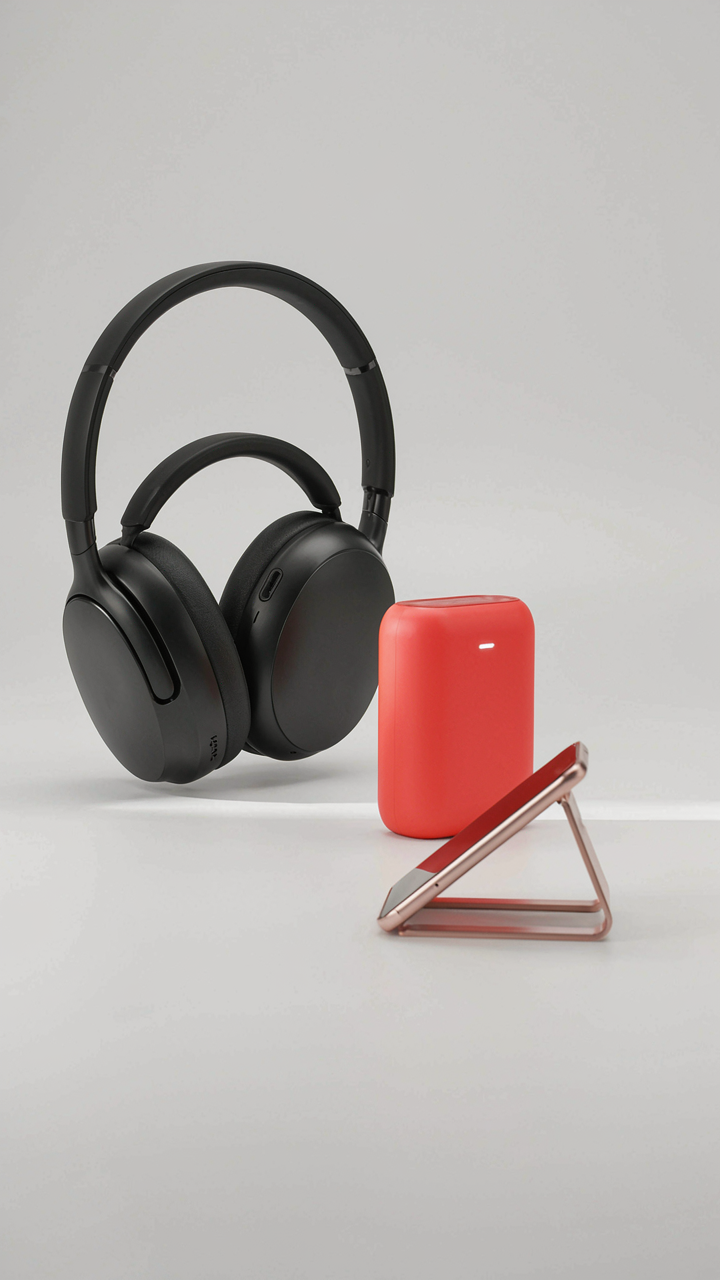
You want to look thoughtful without looking like you panic-bought from a mall kiosk. The real mechanism here comes from industrial design: constraint. When you limit the basket to three core problems instead of twelve random gadgets, each item becomes functional rather than decorative. Noise cancellation, power delivery, and connectivity are the unstated needs behind most tech gift friction. Everyone owns too many charging cables that don’t work with anything. Everyone sits in rooms with ambient noise they tolerate instead of eliminate. Everyone’s device dies at the wrong moment. These three gaps exist in every recipient’s life.
The basket that solves one of these problems cleanly beats the basket that attempts eight mediocre solutions. A quality noise-cancelling headset does more than provide audio. It creates a boundary between the user and their environment, which is what people actually want but can’t articulate. That’s why they matter more than a novelty item that triggers a smile for thirty seconds before drawer exile.
Investment Pieces Versus The Junk Spiral
Most gift advice tells you to mix expensive and cheap items. That’s incomplete. Cheap tech gifts train the recipient’s brain to expect disposability. Each sub-par bluetooth speaker or plastic charging dock reinforces the message that tech is consumable, not valuable. Economics calls this price signaling, and it works in reverse: low-cost items in a gift basket communicate low regard, even unintentionally. The recipient unconsciously values the entire basket based on its lowest-quality component.
Build the basket around one solid investment piece that holds value and performs for years. A reliable power bank with actual fast-charging specs. A quality phone stand engineered to not slip. Noise-cancelling earbuds from a brand with real heritage in audio. Then use the remaining budget for one or two complementary items that extend that piece’s utility, not compete with it. The protocol is simple: one anchor piece, zero filler, every addition serves the anchor’s function.

Hacking The Budget: Leveraging Open Source & DIY Tech Gifts

When Hardware Becomes Education
You want to look smart without spending like it. That’s the real calculus here. Open-source hardware platforms like Raspberry Pi and Arduino sidestep the markup problem entirely because they’re designed by communities, not marketing departments. A Raspberry Pi costs thirty-five dollars. A prebuilt media center or smart home controller costs three hundred. You’re buying the same capability but at production cost, not retail markup. The recipient gets a functional device and the option to learn how it works.
Arduino boards sit lower on the price scale still. They’re microcontrollers, not full computers. That distinction matters. Arduino solves a specific problem: taking sensor input and triggering an output. A temperature sensor feeds data to an Arduino, which then controls a fan. A motion sensor triggers lights. The recipient doesn’t need to understand code initially. They can start with pre-written sketches and modify variables. That progression builds competence without creating friction.
The Leverage Point: Customization Over Commodity
Economics calls this mechanism “value capture through configuration.” You buy a commodity good and extract disproportionate value by tailoring it to the recipient’s actual needs. Generic tech gifts fail because they assume one use case. A Raspberry Pi in a gift basket becomes whatever the recipient wants to build: a retro game emulator, a weather station, a network security tool, a media server. The device doesn’t change. The perceived value does, because you’ve eliminated the gap between what they own and what they actually want to do with it.
Customization adds learning as a side effect, not an afterthought. When someone assembles their own weather station or configures their own media center, they encounter documentation, troubleshoot problems, and retain the knowledge because they solved it themselves. This is retention through necessity. Include a curated set of pre-written code snippets, wiring diagrams, or a project brief that points them toward one specific build. They’ll spend the next week engaged instead of annoyed. The gift doesn’t end when they unbox it; it starts.

The Ergonomic Efficiency Blueprint: Tech For Well Being

Posture Support That Actually Works
You want this section because you’re afraid your back is already ruined and a gift might fix it. It won’t. But applied biology shows us something clearer: posture isn’t about willpower or “sitting up straight.” It’s about load distribution. Your spine is a stacking problem. When weight distributes unevenly, vertebrae compress asymmetrically. A monitor arm, keyboard tray, or lumbar support redirects force down the neutral axis instead of grinding into discs sideways. The gift works because it changes the physics, not because you try harder.
Most monitor arms fail because people set them too high or too close. The screen should sit at eye level when your gaze moves naturally downward about 15 degrees. Your elbows rest at 90 degrees. Your wrists stay neutral, not bent backward. A quality monitor arm with smooth articulation lets the recipient dial this in once and forget it. A heated lumbar pillow with adjustable firmness addresses sustained compression during long sessions. These aren’t motivational tools. They’re structural corrections that remove the decision from the equation.
Reducing The Friction Of Attention
Digital fatigue isn’t about screen time. It’s about refresh rate mismatch and flicker-induced neural load. Your visual system evolved tracking objects in natural light. Standard 60Hz monitors create imperceptible strobing that your nervous system registers as instability, forcing constant micro-corrections. A 120Hz or 144Hz monitor eliminates this burden. Blue light filtering is overstated, but reducing overall brightness and contrast variance matters. The mechanism is load reduction, not comfort theater.
A mechanical keyboard with tactile feedback does the heavy lifting here. Silent rubber domes force your fingers to bottom out on every keystroke, creating repetitive micro-impacts that accumulate into fatigue. Mechanical switches with proper actuation points let fingers rest at the break point without bottoming out. Pair this with a wrist rest that supports the forearm, not just the wrist, and you’ve compressed the energy cost of an eight-hour day. The gift recipient notices they’re less exhausted, not because they’re typing better, but because each keystroke demands less neural overhead. Install the keyboard and measure typing time to baseline fatigue.

The “Digital Detox” Electronic Gift Basket: Unplugging With Purpose

Analog Tools That Complement Digital Life
You’re buying this basket because you want to signal that you understand the problem without actually solving it for yourself. The real mechanism: analog tools work because they demand single-task focus. Your brain can’t context-switch on paper the way it does between notifications. A fountain pen, leather journal, or mechanical typewriter forces linear thinking. These aren’t anti-tech statements. They’re friction devices that make distraction costly.
The best analog gifts pair with existing digital workflows instead of competing against them. A quality notebook becomes useful when someone actually commits to morning pages or meeting notes instead of voice recordings they never replay. Mechanical pencils, drafting pads, and hardcover journals create what designers call “input friction.” This isn’t weakness. It’s protection. The friction prevents the tool from becoming another dopamine machine.
Creating Intentional Breaks From Screens
Most advice treats screen breaks as willpower exercises. That’s backwards. Behavioral psychology proves environment design beats motivation every time. You can’t willpower your way out of a notification. You structure your space so the break happens automatically. A gift basket that enables this contains tools for specific offline activities, not vague ideas about “disconnecting.”
Chess sets, board games, building kits, and analog music instruments create competing attention. They’re not expensive. They’re irreplaceable because they occupy hands and mind simultaneously, which screens cannot do. The mechanism is substitution, not subtraction. You’re not removing digital time through guilt. You’re replacing it with something that demands presence. The gift works when the recipient reaches for the physical object before the phone.

Curating A Technology Basket: The Problem Solution Matrix

Match Pain Points To Actual Tools
You want the recipient to think you understand them. That’s the real reason you’re reading this. Most gift-givers skip the diagnostic step and buy what’s trendy, which lands in a drawer. The mechanism is simple: people use what solves a friction point in their actual day, not what looks good on unboxing video.
Start by naming the specific problem. Not “they travel a lot” but “their phone dies by noon on flights” or “they can’t charge multiple devices in hotel rooms.” This moves you from guessing to solving. Once you’ve named the problem, the gift becomes obvious. A 25,000mAh portable battery solves the first. A multi-port USB-C charging hub solves the second.
- Battery anxiety: Portable power banks between 20,000 and 30,000mAh address full-day drain for heavy users without adding backpack weight.
- Cable chaos: Multi-port USB-C and USB-A hubs reduce desk clutter and eliminate the “which cable is where” search tax.
- Screen fatigue: Blue light filtering glasses or monitor light bars tackle eye strain for people staring at screens eight plus hours daily.
- Audio leakage: Noise-isolating earbuds or over-ear headphones with ANC stop interruptions for remote workers in shared spaces.
- Heat throttling: Laptop cooling pads prevent performance drops during intensive work sessions or gaming, extending device lifespan.
Every item in your basket should map to one named friction. If you can’t articulate why they need it, they won’t use it. This discipline cuts through the noise of what’s merely popular and lands on what actually works in someone’s life.
Basket Design For Different User Types
The mistake people make is treating all tech users as the same. A student needs different tools than a frequent flyer, who needs different tools than someone working from home. Match the basket composition to their actual context.

The traveler basket prioritizes portability and redundancy. Include a compact charging brick, a cable organizer, a small power bank, and a TSA-approved phone stand. Weight matters. The remote worker basket focuses on workspace optimization: desk-mounted monitor arm, ergonomic keyboard, wrist rest, cable management clips. The student basket leans on productivity and affordability: tablet stand, stylus, affordable wireless earbuds, USB hub. Each archetype has different pain points, so each basket has different contents. The composition isn’t random. It’s built from the constraints of how that person actually works.
From Raffle Basket To Strategic Asset: Gifting For Impact

Tech As Skill Infrastructure
You want to feel like you picked something meaningful instead of just expensive. The real mechanism is this: most tech gifts fail because they’re novelty first, utility second. A gift only matters if it solves friction in someone’s actual workflow or closes a skill gap they already want to close. That’s the difference between a drawer item and a tool someone uses daily.
The best tech gifts function as leverage. A wireless keyboard isn’t about convenience, it’s about enabling someone to work from anywhere without compromise. A decent webcam doesn’t just improve video calls, it removes the barrier between someone’s expertise and their ability to share it. When you pick tech that removes a specific friction point, you’re not gifting a product, you’re gifting capability.
Impact That Compounds Over Time
Economics calls this depreciation, but tech gifts work in reverse: they appreciate through use. A budget ring light gets used once for a video call, then sits unused. A ring light that matches someone’s actual output schedule becomes part of their infrastructure. The ROI isn’t measured in months, it’s measured in what they build with the tool.

Thoughtful tech gifts create behavioral shifts because they lower the activation energy for work that matters. Someone with proper cable management stops losing time to tangled cords. Someone with task-specific tools stops context-switching between solutions. Build your basket around reducing one type of friction, and the gift compounds through every use. That’s not novelty value, that’s economic value.
The Real Obstacle Isn’t Your Budget, It’s Your Imagination

Most people gift the same tired electronics everyone already owns. You won’t. Stop treating gift baskets like checkboxes and start treating them like puzzles. Pick one person. Write down what they actually do, not what they should do. Then buy things that solve real friction in that life. Open Amazon right now and add three items to your cart based on that person’s actual behavior, not generic tech bro logic. The best gift isn’t the most expensive tool, it’s the one that proves you were actually paying attention.