The Illusion Of Endless Distraction: Why More Isn’t Better

When Choice Becomes Paralysis
You want to feel prepared. You’re hoping that loading up your kit with every option available means you won’t be bored, won’t feel trapped, won’t waste time at 35,000 feet. That’s the real fear underneath this. But here’s the mechanism: psychology calls this the paradox of choice. Too many options trigger decision fatigue before the plane even leaves the gate, then regret during the flight when you realize you picked wrong and can’t easily switch.
Airlines and kit manufacturers exploit this by stuffing seatback pockets and carry-ons with movies, games, books, and tablets. More selection sounds like more value. It’s not. The cognitive load of evaluating dozens of options consumes the mental energy you’d spend actually enjoying one thing. You scroll through 200 titles and watch 15 minutes of three different ones. You bring four books and finish none. The kit becomes a source of friction instead of relief.
Depth Over Volume On Every Flight
The common advice says pack variety to keep both kids and adults entertained. That’s incomplete. Focused work and deep engagement beat passive consumption every time, and the mechanism is attention residue. When you task-switch constantly, your brain leaves fragments of attention on each activity. One sustained project or story creates the opposite effect: flow, where time collapses and boredom disappears.
Build your kit around depth, not breadth. Bring one genuinely compelling book instead of three mediocre ones. Choose one game or puzzle that requires real strategy instead of six that require none. For kids, a single complex activity like building a model or working through a detailed workbook outperforms a pile of cheap toys that get abandoned after minutes. The constraint forces engagement instead of allowing escape into the next distraction.
The Minimalist’s Flight Strategy: Essential Plane Activities For Kids & Adults

What Actually Fits In The Overhead Bin
You want to feel prepared without lugging a carry-on that makes you look desperate. The real mechanism is constraint forcing priority: a flight’s duration and seat width dictate what matters, not what sounds impressive at the gate. Most people overpack entertainment because they mistake volume for security. You don’t need fifteen items. You need items that occupy minimal physical space while delivering engagement density across different mental states—boredom, restlessness, focused attention, wind-down.

The economics of airplane entertainment demand one calculation: weight and dimension against utility hours. A single paperback novel occupies less space than a tablet case but requires no battery. Noise-canceling earbuds with a phone weigh almost nothing but unlock hours of podcast or audiobook engagement. Pen and paper cost nothing and work without power. The constraint isn’t what you bring; it’s ruthlessly eliminating what you don’t use before takeoff. Pack for the flight you’re actually taking, not the one you imagined during trip planning.
Tools That Compound Across Hours
Borrowed from systems thinking, the principle of “leverage” applies directly to flight entertainment: one tool that serves multiple purposes multiplies your effective payload without adding weight. Most advice suggests packing separate items for separate needs. That’s padding. The actual move is identifying tools with architectural flexibility built into their design.
A notebook with quality paper works as journal, sketch pad, puzzle surface, and writing space for kids. Wireless earbuds enable podcasts, audiobooks, music, or films on a device you already own. A deck of cards occupies three inches of space but entertains two to four people across multiple games and difficulty levels. A pen works for crosswords, note-taking, sketching, and marking progress in a book. Your phone itself becomes the entertainment hub for reading, video, gaming, and communication. The protocol: before packing, assign each item at least two distinct uses. If it has only one purpose, leave it behind.
The “Deep Work” Flight Protocol: Leveraging Confinement For Productivity

The Airplane As A Focus Machine
You want to believe the flight itself will make you productive. It won’t, unless you stop treating it like a vacation from discipline. The real mechanism at work is removal: an airplane forces external constraint that your brain interprets as permission to go deep. Borrowing from information theory, airlines create a “bandwidth bottleneck”—the internet is either absent or prohibitively expensive, which collapses your menu of distractions to nearly zero. No Slack. No email refresh loops. No social media tabs. Your nervous system recalibrates because the escape routes are actually closed.

Most people waste this setup by bringing a phone and calling it enough. That’s not a focus capsule, that’s just a seat change. A real airplane entertainment kit for deep work strips the device down before boarding: close your email client, delete apps temporarily, turn off notifications entirely, and load only the content you need for your task. The physical confinement plus deliberate constraint compounds into something your home office cannot replicate. You pay to be trapped. Use that.
Designing Your Task Stack Before Takeoff
Common advice says “bring something you’ve been meaning to do.” That’s too vague and guarantees failure. You need to front-load the cognitive work—decide exactly which tasks fit the flight duration, their sequence, and what materials they demand. A six-hour flight is not a blank canvas. It’s a fixed container with specific constraints: no collaboration, no external research loops, no waiting for information from other people.
Map your airplane entertainment kit to tasks that require uninterrupted blocks and produce measurable output. Writing chapters, designing systems, editing existing work, strategic planning, deep reading of dense material—these scale to flight time. Bring your outline, your draft, your reference documents in paper or offline-ready PDFs. The moment you land, you move to the next task. No carry-over means you’ve extracted maximum value from the constraint itself.
Kid Plane Activities: Beyond The Screen The “Engagement Economy” Model

Attention As Currency On A Confined Route
You want your kid quiet so you look like a competent parent and don’t absorb judgment from strangers. That’s the real reason this matters. But here’s the mechanism: attention is scarce on a plane. Your child has limited mental energy before fatigue sets in or overstimulation breaks them. Economics teaches scarcity drives value. Screens are the low-cost option that depletes attention fastest. High-value activities in this economy preserve attention for later phases of the flight when you need it most.
The plane is a closed system where boredom compounds exponentially. A child who burns through screen time in hour two has nothing left for hour four. Instead, design your kit around activities that engage without draining. Puzzle books, construction systems, and tactile play hold attention longer because they require active problem-solving instead of passive consumption. The goal isn’t entertainment density. It’s sustainable engagement that extends across the entire flight duration without backfiring into restlessness.
Build With Systems, Not Novelty
Most parents pack a collection of disposable toys, each good for fifteen minutes. That’s the wrong model. Reusable, open-ended systems—think building blocks, magnetic tiles, or modular drawing kits—compound in value as your kid plays. They generate novelty internally through recombination instead of requiring new items. Your child uses the same set across multiple flights, reducing cost per hour of engagement and eliminating the dead time spent figuring out what to play with next.
The design principle here is modularity. A set of interlocking blocks becomes a house, then a tower, then a vehicle. The system grows with your kid’s imagination instead of limiting play to one predetermined outcome. Pack systems that tolerate the plane’s confined space and vibration without pieces scattering into inaccessible seat gaps. Magnetic construction kits, reusable sticker books, and lap desk organizers with contained activities all meet these constraints. Before boarding, verify each item fits your lap tray or a small backpack. Prep the kit the night before so you’re not assembling entertainment in the security line.
The “Cognitive Reset” Kit: Airplane Busy Bags For Kids & Adults

Mental Clarity Over Numbing
You want your kid quiet and compliant, or yourself distracted enough to forget you’re trapped in a metal tube at 35,000 feet. That’s the real ask here. But numbing the brain and resetting it are opposite operations. True mental clarity on a flight comes from activities that demand focused attention without overstimulation, then release that tension systematically. This isn’t entertainment masquerading as rest.

Borrowing from neuroscience, the brain operates in frequency bands, and airplane entertainment typically locks you into the delta wave state of passive consumption. A cognitive reset kit instead cycles through beta (focused work), alpha (alert relaxation), and theta (creative flow) states. Puzzle books, pen-based activities, and single-object focus tools accomplish this. They keep the prefrontal cortex engaged without the dopamine crash that follows screen time. Pack physical materials that require hand-eye coordination and problem-solving, not passive scrolling.
Focused Work Breaks The Cabin Mentality
Most airplane kits fail because they treat the flight as a unit to be managed rather than segmented into discrete work blocks. Adults carrying work materials and focused writing prompts into a flight report higher arrival energy than those who defaulted to movies. Kids with structured drawing challenges and spatial puzzles show less behavioral escalation mid-flight than those rotating through unrelated entertainment.
The mechanism is simple: constraint breeds focus. Provide one activity with clear parameters and duration, not an undifferentiated pile of options. Include a small notebook for directed prompts (draw one object from five angles, write three observations about what you see outside), reusable sticker books with specific scenes rather than open-ended ones, and tangram or wooden puzzle sets that demand sequential problem-solving. Rotating between these over two-hour intervals maintains cognitive engagement without fatigue.
Analog Advantage: Why Low Tech Wins In The Air
The Battery Problem Solves Itself
You’re afraid of boredom. That’s the real reason you care about this section. You want proof that your kit won’t collapse halfway through a five-hour flight. Here’s the mechanism: batteries deplete on a predictable curve, but analog tools operate on a different system entirely. A pencil doesn’t drain. A book doesn’t crash. A deck of cards doesn’t require Wi Fi.
The cabin environment kills device performance faster than ground conditions. Altitude pressure, humidity swings, and temperature fluctuations all stress lithium cells. A tablet charged to 100 percent loses 15-20 percent of capacity in the first two hours at cruising altitude due to how batteries manage thermal regulation in pressurized cabins. Analog tools ignore all of this. They work the same at 35,000 feet as they do on the tarmac.
Friction Creates Focus
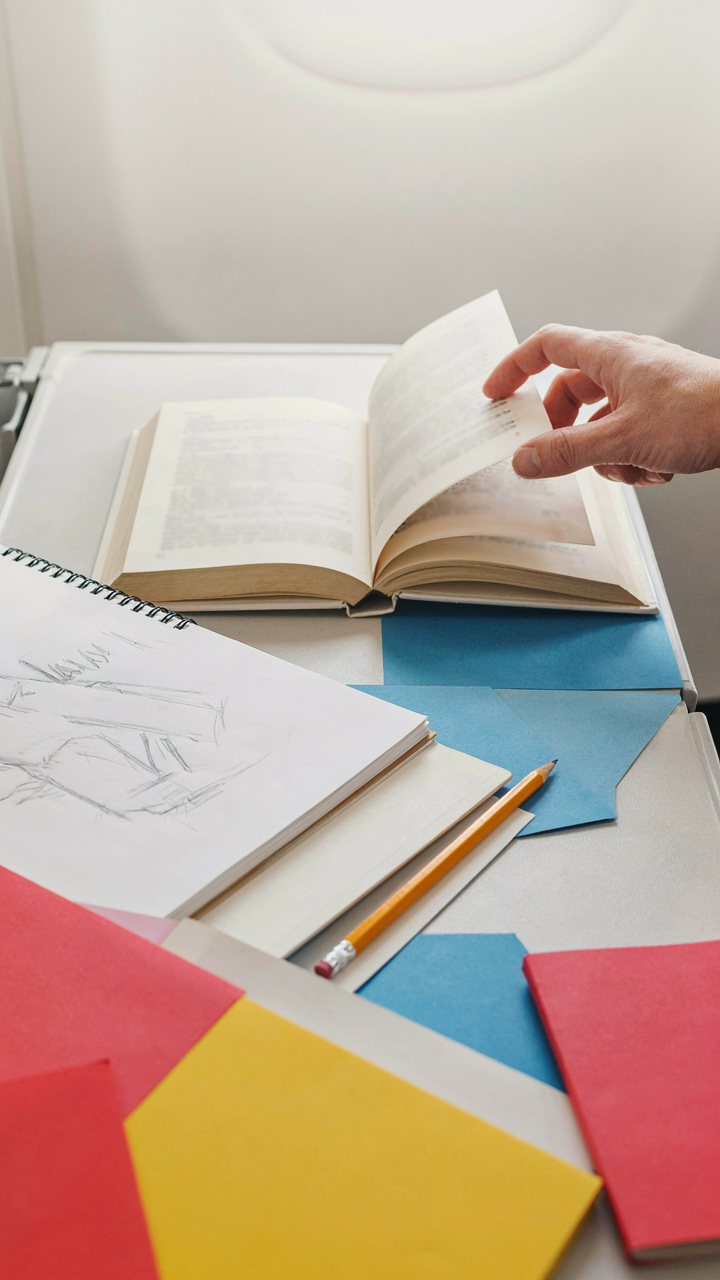
Tactile engagement works through a principle borrowed from neuroscience called embodied cognition: your hands are part of your thinking process, not separate from it. When you hold a pencil and move it across paper, your brain fires differently than when you swipe a screen. The resistance matters. The physicality matters.
Screens are frictionless by design. Your thumb glides. Your eyes dart. Your attention fragments across notifications and ambient possibility. A paperback novel, a sketchpad, or a puzzle demands sustained contact. You can’t skim tactile experiences. Your fingers must move through them sequentially. This forced slowness is precisely why analog tools sustain engagement for longer periods without mental fatigue or the compulsive refresh cycle that screens create.
Plane Ideas For Kids: The “Novelty Engine” Approach
New Items Beat Familiar Ones
You want your kid quiet for five hours without screens because you’re terrified of judgment from other passengers. Here’s the mechanism: novelty triggers dopamine release faster than familiarity does. A toy they’ve seen before is processed by the brain as low-priority information. An unfamiliar item demands attention. The airplane cabin’s confined space and monotony amplify this effect. Kids default to boredom because their brain has already categorized everything in their usual environment. Introduce something they’ve never encountered, and you’ve reset their attention clock.

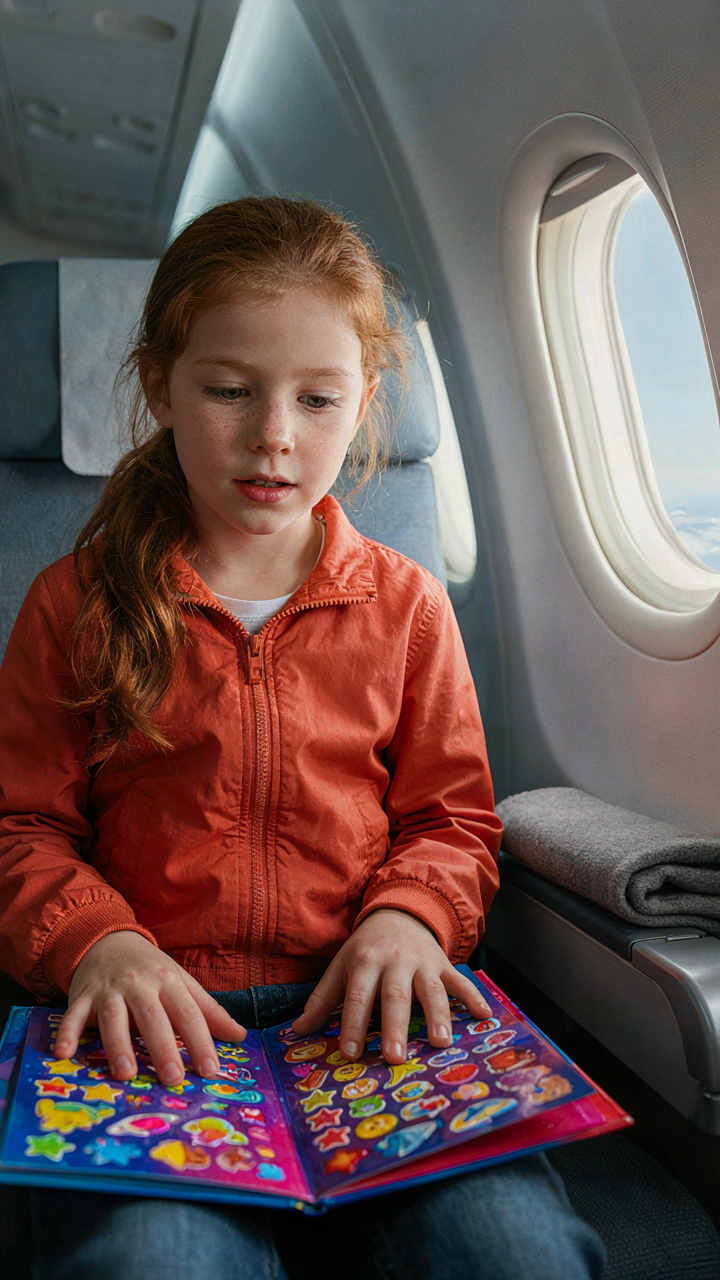
The mistake parents make is packing entertainment they already own. A coloring book from home signals “this is old” to a kid’s neural system within minutes. Instead, source items specifically because they’re foreign to the child’s experience. Think tactile variety: textured sticker books, magnetic puzzle types they haven’t seen, construction sets with unusual connector systems. The unfamiliarity itself becomes the entertainment. You’re not filling time. You’re hijacking their novelty-detection system.
Strategic Item Release Schedule
Here’s what works during a flight:
- Window reveal (first 30 minutes): Open a small gift-wrapped item as takeoff settles. Something tactile like stress putty or pop-it fidget toys. The wrapping adds ceremony and delays gratification.
- Mid-flight surprise (2-3 hour mark): Release a construction or puzzle item. Magnetic tiles, building blocks, or interlocking puzzle sets sustain focus longer than single-use items.
- Snack interval gift (4-5 hour mark): Pair a small novelty with meal service. A new book, activity pad, or STEM-style challenge kit that connects to real-world concepts.
- Descent distraction (final hour): Save screen-based entertainment or a high-engagement item for when cabin pressure shifts cause restlessness and ear discomfort.
- Reserved backup item: Keep one sealed item untouched until behavioral breakdown occurs. Use it as a reset mechanism, not routine entertainment.
Spacing matters because each reveal resets the novelty cycle. Kids experience time differently in confined spaces. A four-hour flight feels longer to them. By spacing surprises, you’re not extending entertainment. You’re segmenting the flight into distinct phases, each with its own opening act. Pack more items than you think necessary. Unused novelty is wasted budget. Rationing items across the flight duration prevents the moment when every option feels stale.
The Strategic Parent: Curating The Ultimate Kid Travel Kit

Let Kids Choose Their Own Entertainment
You want your kids calm on the plane so you don’t look like you’ve lost control. The real mechanism is choice architecture. Kids resist what gets imposed on them. They comply with what they select. When a child picks their own entertainment, they’ve already committed to using it. They own the decision.

Have your kids pick three to five items from a curated list two weeks before departure. Not unlimited options, not zero options. You control the pool, they control the selection. This separates the parent who shows up with random items from the parent who built buy-in before takeoff. The kid becomes the curator of their own flight experience.
Flight Boundaries Before Boarding
Generic advice says “set rules” and leaves it there. That’s incomplete. The rule without context gets broken the moment boredom hits. Kids need to understand the constraint, not just hear it repeated.
Explain the mechanics of the flight to your kids before boarding. Headphones stay on during the movie. You get one snack request per flight hour. Entertainment gets rationed so you’re not out of content by hour three. These aren’t punishments. They’re operating parameters, like fuel limits for an aircraft. The kid knows the structure in advance and can plan around it. When you enforce the boundary later, you’re not surprising them. You’re holding a line they already accepted.
Airplane Kits For Kids: Beyond The Hype What Actually Works

Activities That Build, Not Just Occupy
You want your kid quiet on a six-hour flight, and you’re hoping a kit buys you peace without guilt. That’s not the real problem. The mechanism is simple: boredom tolerance atrophies faster than muscle. Kids who only consume pre-made entertainment lose the ability to generate their own engagement. A real airplane kit trains focus and problem-solving under constraint, not just kills time until landing.

Look for activities with incremental difficulty. Magnetic puzzles that start simple then require spatial reasoning. Reusable sticker scenes where kids compose narratives instead of just peeling and placing. Drawing prompts that ask “what if” instead of “copy this.” The kit should demand thought, not just attention. This is how you actually prepare a child’s mind for boredom immunity, not escape from it.
Challenges Scaled To Real Capability
The common advice says give younger kids simple tasks and older kids complex ones. That’s incomplete. The real variable isn’t age, it’s mastery gap. A ten-year-old bored with a puzzle designed for eight-year-olds will abandon it in two minutes. The kit needs tasks at three distinct difficulty levels so kids can self-select based on engagement, not age.
Include challenges that connect to skills they’re building in school but don’t feel like homework. Logic grids that strengthen pattern recognition. Narrative building exercises that strengthen writing without the pressure of evaluation. Word searches work because they give immediate feedback: found or not found. This is why they persist longer than open-ended activities. The flight ends when your kid reaches the hardest level they can solve, not when the kit runs out.
Travel Activities: Reclaiming The Journey, One Flight At A Time
The Flight As Productive Container
You want to feel like you didn’t waste five hours of your life. That’s the real math here. Most people treat flying as dead time, then wonder why they land depleted. The mechanism is simple: an airplane entertainment kit transforms a constraint into a bounded work session. You have fixed duration, zero distractions from ground life, and forced sitting. That’s a production environment most people pay consultants to architect.
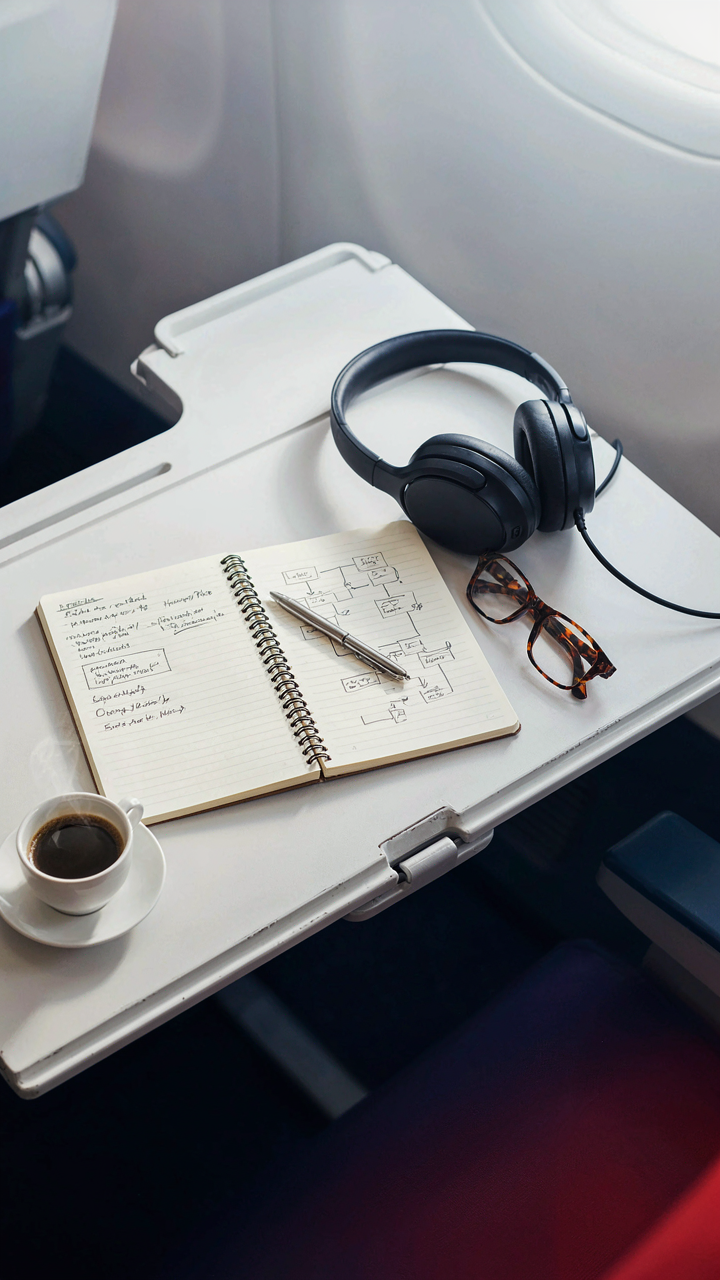
A proper kit acknowledges this. You’re not entertained into numbness. You’re equipped to execute. Noise-canceling headphones, a notebook, reading material tied to an active project, a deck of cards for strategic thinking breaks. The airline seat becomes a deliberate workspace, not a waiting room. Arrival matters less than the output you ship during those hours aloft.
Landing Sharper Than You Left
The common advice here is wrong. “Relax on the plane, recharge your batteries.” That’s backwards for most people. You arrive at your destination already behind on what you didn’t do, plus the fatigue of passive consumption. The real play is the opposite: use the containment to produce, then land ahead of schedule. From an energy standpoint, productive constraint beats prescribed rest every time.
An entertainment kit designed this way keeps your mind engaged at high capacity, not drained by scrolling and half-attention. You finish a flight with completed work, notes on a problem solved, or a skill practiced. Your nervous system lands in execution mode, not recovery mode. That state carries forward into your destination. Pack accordingly.
The Real Obstacle Isn’t Boredom; It’s Your Untrained Focus In A Distraction-rich World

You already own an airplane entertainment kit. It lives in your pocket. The real problem? You’ve trained your brain to expect constant novelty, so five minutes of anything feels like torture. Stop blaming the flight. Build your attention span like a muscle. Tomorrow, sit with one book for thirty minutes without switching apps. Your future self won’t waste eight hours scrolling through a mediocre entertainment menu because you’ll actually know how to be present. Focus is the only entertainment system that matters anymore.