
The Layover Leverage Principle: Reclaim Your Focus

Plan Your Work Before You Leave Home
You want to feel productive during a layover because sitting idle makes you anxious about wasted time. The mechanism is simple: your brain defaults to distraction when you haven’t pre-decided what to do. A layover gives you 4 to 8 hours of uninterrupted time that rarely exists in normal life. Most people waste it scrolling because they never committed to a task before boarding.
Write down one specific project before you leave. Not “get work done.” Specific: edit three pages of copy, outline a proposal, research five competitors, draft an email series. Estimate the time needed. This removes the decision tax that kills momentum the moment you sit down. Your layover becomes a sprinting ground, not dead time.
Deep Work In Plain Sight
The common advice says find a quiet corner. That’s incomplete. Airplane mode is the real lever here, borrowed from neuroscience’s concept of cognitive load. Your device becomes a tool instead of a notification dispenser. You strip away every channel competing for attention.
Enable airplane mode before landing. Close all browser tabs except what serves your task. Kill Slack, email, messages, news apps. You’re not ignoring urgency, you’re creating the condition where focus exists. A layover is one of the few places you can work without your phone pulling you into a dozen directions. Use this scarcity. Work for 90 minutes, take a 15-minute break, work again. Track your output, not the time spent.
The 3 Hour Decompression Protocol

Move Your Body Before Your Mind Goes Numb
You’re worried you’ll waste time sitting. That’s the real problem here. The mechanism is simple: airports are designed to trap you in static positions, and your nervous system responds by shutting down. Apply the physics concept of momentum to layover behavior. Objects at rest stay at rest. You must generate initial movement to break the terminal zombie-state before it locks in.

Walk a full terminal loop before you sit down. Not a casual stroll. Intentional walking for 12 to 15 minutes raises your heart rate enough to reset your baseline energy. Find stairs or an incline if available. The goal is to activate your legs and lungs, not to arrive somewhere. After this, everything else you do lands harder because your physiology is primed instead of dormant.
Refuel On Specificity, Not Calories
Most layover eating advice is garbage because it treats food as time-filling. You don’t need to eat more. You need to eat strategically to prevent the energy crash that makes the remaining hours feel infinite. Your blood sugar and hydration state directly control how fast or slow time feels subjectively. Dehydration and simple carbs create the crash-and-drag cycle that destroys a layover mentally.
Eat protein and fat first. Nuts, cheese, a protein box from a café. Skip bread and sugar entirely. Drink water until your urine is clear. This combination stabilizes your glucose and keeps your attention span functional for the rest of the layover. You’ll notice the difference in mental clarity within 30 minutes. The protocol is protein, water, then movement again if energy dips.
Beyond The Gate: Understanding Airport Layovers As Opportunity

The Micro Adventure Play
You’re worried you’ll waste time and look foolish trying something outside the terminal. That’s the real friction. Here’s the mechanism: airports sit inside cities with concentrated infrastructure. Museums, parks, and food exist within taxi or transit distance. A layover isn’t a penalty box—it’s a forced boundary that makes decisions easier. Most people default to the gate because deciding feels risky. The opposite is true.

A micro-adventure is economics language applied to constrained time: maximize output within fixed parameters. You have four hours. You pick one thing with a clear start and end. A museum visit near the airport takes ninety minutes door-to-door. A meal at a restaurant locals actually use takes sixty. A walk through a neighborhood takes thirty. The constraint forces specificity. Vague plans die in airports. Specific ones execute.
The City Sprint Method
Most layover advice says “take a tour” or “explore the area.” This is lazy. Tours route you through curated zones. You see what’s packaged, not what’s real. The real mechanism comes from military strategy: you establish a perimeter, move with purpose, and extract before conditions change. A city sprint means you pick a single neighborhood within transit distance, move directly there, hit two to three specific locations, and return with buffer time. No browsing. No “see where we end up.” You decide the neighborhood before you land.
Strategy requires constraints. Research the city before arrival. Identify one neighborhood. Book a restaurant or reserve a museum slot. Know the transit line and ride time. Check return schedules backwards. You land, move fast, execute, return. The goal isn’t to “experience the city.” The goal is to interrupt the airport loop and reclaim the layover from dead time. Do this correctly and you’ll spend three hours outside the terminal and still board early.
The Cognitive Recharging Circuit: Airport Layover Relaxation Tips

Blocking Noise And Light
You’re afraid you’ll waste the layover feeling drained instead of refreshed. The mechanism is simple: your nervous system runs on signal-to-noise ratio. Airports pump constant low-level stimulation—announcements, rolling luggage, conversations, fluorescent hum. Noise-canceling headphones and an eye mask don’t block everything. They lower the cognitive load your brain spends filtering irrelevant input, freeing capacity for actual rest. This is why silence feels restorative, not boring.

Most people buy cheap noise-canceling gear and expect magic. The real play is matching the tool to the task. Over-ear headphones with passive isolation work better than earbuds for airports because they seal the ear canal. An eye mask matters less for darkness and more for signaling to your brain that rest mode is active. The signal matters more than the darkness itself. Bring both, use them together for 20 to 30 minutes, then move.
Leveraging Your Sleep Architecture
Power napping sounds easy until you realize most people sabotage their own biology. Sleep science shows ultradian rhythms, not willpower, govern how much rest you extract from limited time. A 20-minute nap catches light sleep stages. A 90-minute nap completes a full cycle including REM. Anything between 30 and 60 minutes leaves you in deep sleep, making you groggier than before.
The tactical move: know your layover length and pick a nap window that aligns with your biology, not your schedule. A 3-hour layover supports a 20-minute power nap or a 90-minute full cycle if you have a quiet spot. Set an alarm 5 minutes before you need to move. Lie down immediately after eating something light with protein and fat to stabilize blood sugar during sleep. You wake recovered instead of groggy only when the timing matches your sleep architecture.
Best Airports For Long Layovers: Not All Hubs Are Created Equal

Amenities Beat Location Every Time
You’re choosing airports based on layover duration, not on where they sit on a map. That’s the real calculation here. Most people pick hubs by airline alliance or geography. Wrong move. The mechanism is simple: airport design determines how fast you can move through space and access what matters. A poorly designed major hub wastes three hours. A mid-tier airport with deliberate infrastructure saves two.
- Singapore Changi: Free shower facilities, spa access, extensive retail and dining across terminals. Designed explicitly for long layovers with rest areas and sleep pods available for purchase.
- Istanbul IST: Extensive shopping district, Turkish Airlines lounge access tiers, clear wayfinding between terminals. High-quality food options at reasonable prices compared to other major hubs.
- Munich: Efficient terminal layout, extensive dining variety, tech-forward amenities like phone charging stations. Lounge access relatively accessible through airline partnerships and day passes.
- Doha Hamad: Free wifi, prayer facilities, modern seating, quick access to retail without excessive walking. Designed for passenger flow efficiency across multiple terminals.
- Abu Dhabi Etihad: Spa and shower facilities, diverse food courts, clear signage, relatively compact layout despite size. Day passes to lounges are affordable and widely available.

The common advice is to book layovers through your preferred airline hub. Reality: book layovers through airports that invested in passenger experience, not just throughput. Check terminal maps before booking. Measure walking distances between gates and amenities. The difference between a wasted layover and a functional one is whether the airport built for the person sitting there or just for the flights moving through.
Efficiency Mapping Beats Random Wandering
Airport infrastructure isn’t accidental. It follows supply chain logic: minimize handoff time between nodes. Your layover is a node. The terminal layout, lounge locations, and gate clustering either work for you or work against you. Most travelers don’t study this before landing, which means they waste an hour finding basics.
Pull up the airport map on your phone before departure. Identify your arrival gate, your departure gate, and the fastest route between them. Mark bathroom locations, water fountains, and food options on that route. This takes eight minutes and cuts your navigation time by half. Some airports cluster restaurants and lounges near specific gates. Others spread them across terminals. Know which situation you’re in. Walk the route mentally before you walk it physically. Your layover clock stops when you reach your departure gate, so everything before that is negotiable time you can actually use.
The Information Diet: Travel Tips For Airport Layovers

Curated Consumption Over Passive Scrolling
You’re afraid you’ll waste the layover, so you grab your phone and let algorithms decide what you see for three hours. The real mechanism is attention capture: platforms are engineered to extract duration, not deliver value. Treat your layover like a signal-to-noise problem in information theory. Every minute scrolling is a minute not building, learning, or recovering.

Download content before you land. Bring one book, one course, one podcast series you’ve already vetted. The constraint forces choice. You stop scrolling and start consuming something with actual density. Airport wifi is unreliable anyway. Offline content eliminates the decision loop that kills layovers.
Clearing Your Inbox Before The Gate Closes
Email during layovers feels productive because you’re responding to other people’s urgencies, not your own. The work expands to fill the time, and you land feeling drained instead of refreshed. Inbox zero on the go means processing, not just reading: reply, delete, archive, or defer everything in one pass.
Set a timer for twenty minutes. Go through messages ruthlessly. Anything requiring more than two minutes goes into a notes app to handle later. Defer decisions on non-urgent items. The goal is to clear your mental backlog so you don’t spend the layover anxious about what’s waiting. Once your inbox is empty, close email entirely and don’t reopen it.
The Bio Rhythm Optimization Protocol

Light Exposure Strategy For Circadian Reset
You want to feel normal again because arrival fatigue kills productivity and mood, and nobody wants to waste money looking tired. Circadian rhythm operates like a biological clock set by light exposure, not willpower. Your brain’s suprachiasmatic nucleus responds to light wavelengths before caffeine touches your system.

Seek bright light within two hours of landing if you’re traveling east. Find a window seat in the terminal, sit outside, or use the airport’s observation deck. Light at the right time shifts your internal clock faster than sleeping. If traveling west, delay light exposure by a few hours. This single input resets your rhythm without fighting against biology.
Hydration And Fuel Before Fatigue Sets In
Generic travel advice says “stay hydrated,” which is useless because it ignores why you’re actually dehydrated and crashing. Airplane cabins maintain humidity around 10 to 20 percent, drying mucous membranes and accelerating cortisol production. Dehydration masquerades as hunger, jet lag, and mental fog.
Drink water before thirst signals arrive, not after. Electrolyte drinks work faster than plain water because sodium retention matters during travel stress. Eat protein and fat in your layover meals, not carbs alone, because they stabilize blood sugar without the crash. Your energy doesn’t fail from time zones or sitting. It fails from substrate depletion.
The Antifragile Traveler: Airport Tips For Unexpected Delays
Backup Resources Beat Panic
You’re scared you’ll waste eight hours staring at a gate. That’s not really the problem. The problem is you showed up unprepared, which means you’re now at the mercy of whatever the airport decides to give you. Nassim Taleb calls this fragility in his risk framework: a system breaks under stress because it has no redundancy. A layover without backup resources is fragile. You crack under a three-hour delay because you planned for two.

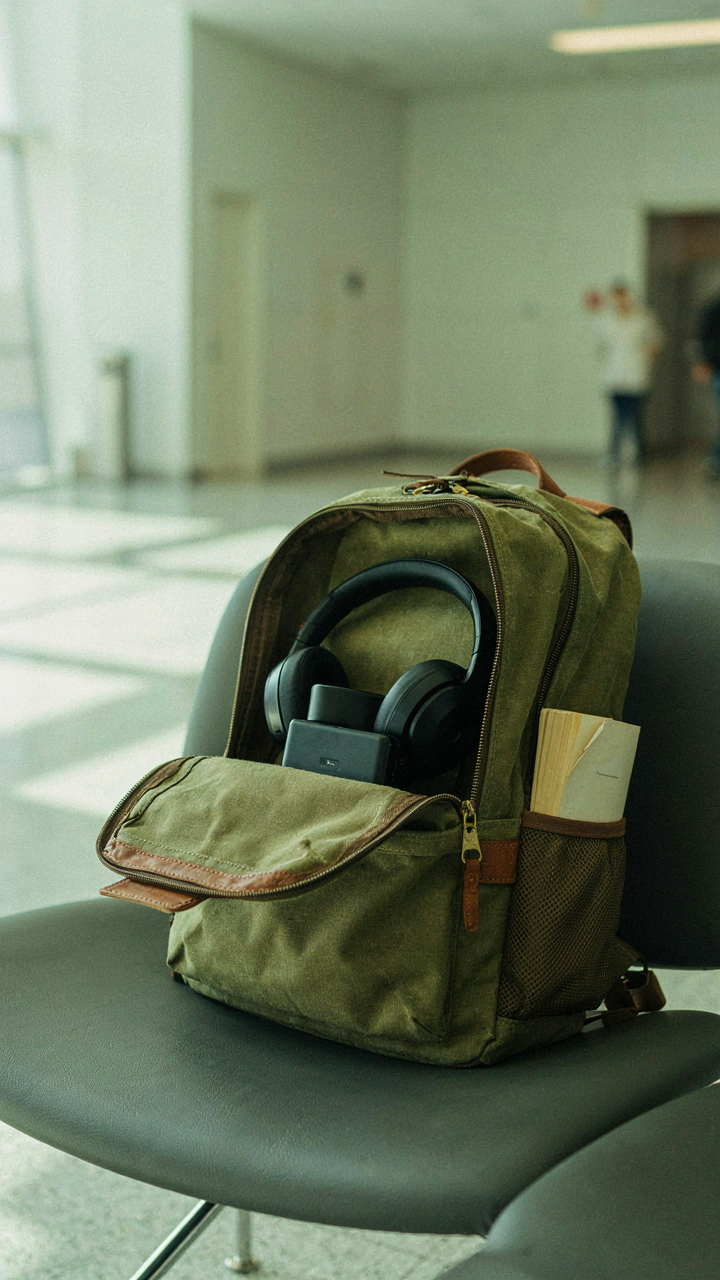
Build redundancy into your layover. Download offline maps, entertainment, and work files before you leave home. Carry a portable charger, noise-canceling headphones, and a physical book. Bring cash and know which airport terminals have functioning outlets. These aren’t nice-to-haves. They’re infrastructure. One backup charger eliminates most airport friction immediately.
Constraint Creates Clarity
The common advice here is to “stay positive” and “reframe delays as opportunities.” That’s incomplete. Your mindset only matters if you have a structure to work within. Psychologically, you’re not reframing anything without a concrete action that fills the time. The real mechanism is this: constraints force prioritization. You can’t do everything in a layover, so delays force you to do one thing well instead of five things poorly.
Use delays as a filter, not a setback. Pick one task before you board: read one book chapter, write one section of work, learn one skill, make one sales call. When a delay hits, you’re not scrambling to invent meaning. You’re deepening work you already started. Delays stop feeling like interruptions and start feeling like bonus time.
Terminal Tactics: Applying Military Strategy To Airport Travel

Scout Your Territory First
You want to feel in control during a layover because uncertainty kills time faster than boredom. Military logistics calls this “reconnaissance”—mapping terrain before deployment—and airports operate on the same principle. The first 15 minutes after landing determines whether you waste two hours or use them strategically. Walk the terminal, locate your gate, identify food vendors, find the lounge entrance, and spot charging stations. This takes one loop, five minutes max.

The common mistake is staying seated at your gate like you’re pinned down. You’re not. Most travelers never explore because they assume all terminals are identical. They’re not. Gate distances vary wildly. Some lounges sit three minutes away, others need ten. Some food courts close before your departure. Charging stations cluster in specific zones. You can’t allocate time or energy without this data. One reconnaissance pass eliminates every decision friction point in your layover.
Deploy Resources With Precision
Military strategy calls resource allocation “distribution of force”—putting the right assets in the right place at the right time. Your layover resources are time, money, and energy, and most people waste them by treating them as infinite. They’re not. A four-hour layover has hard constraints: security clearance time, bathroom visits, walking distance, and departure buffer. That leaves maybe two and a half hours of actual discretionary time.
Stop treating money as the variable and time as fixed. The math inverts in a layover. Spend money to compress time. A lounge day pass costs thirty to fifty dollars and buys you a shower, power outlet, and food without the airport markup. A taxi to a nearby neighborhood costs twenty dollars and gets you actual scenery instead of terminal monotony. A coffee shop with wifi costs seven dollars and anchors two hours of focus. Budget forward. The point isn’t to spend less—it’s to spend strategically so you’re not still sprinting to your gate when boarding starts.
Airport Travel: The Art Of Solitude And Reflection

Write To Process, Not To Pass Time
You want this section because you’re afraid a long layover means wasted hours. Here’s the mechanism: journaling during a layover isn’t about filling pages. It’s about externalizing the mental noise your brain refuses to process while moving. Psychology calls this “cognitive offloading.” You capture half-formed thoughts, decisions pending, observations from travel. The act of writing forces clarity. Most people scroll instead because scrolling requires zero decision-making.
A layover creates conditions you don’t get elsewhere: forced stillness, no obligations, and zero social pressure to perform. Grab a corner seat away from the gate. Write what you noticed about the trip so far, what you’re avoiding thinking about, what the next leg represents. Don’t aim for eloquence. Aim for honesty. The notebook becomes a pressure valve. By the time boarding starts, your mind is lighter and you’ve actually processed something instead of consuming content that dissolves the moment you close the app.
Watch Behavior, Extract Patterns
Airport terminals are behavioral laboratories. Observation isn’t tourism. It’s reverse-engineering human decision-making under constraint. Economics teaches “revealed preference”: what people actually do reveals what they actually value, stripped of what they claim to value. Watch travelers. See who books a meal versus who grabs the overpriced sandwich. Notice who sits near outlets versus who sits with their group. Track which stores get foot traffic and which don’t. This is data about priorities under time and money pressure.
People move through airports like they move through life: either rushed and reactive, or intentional and strategic. The gap between these two groups isn’t effort. It’s clarity about what matters in the moment. Spend thirty minutes watching and you’ll see more about human behavior than you will from a hundred think pieces. You’ll notice gatekeeping patterns, status signals, how people signal their iteration of life through luggage and clothing. This isn’t voyeurism. It’s applied anthropology. Document one pattern you notice. Write down why you think it matters. You now have a real observation instead of dead time.
The True Obstacle Isn’t The Layover; It’s Your Addiction To Constant Stimulation

You don’t have a layover problem. You have a boredom problem. Your brain screams for dopamine hits every three minutes, so eight hours feels like a prison sentence. The real move? Sit alone for two hours without your phone. Do nothing. Think about your life. Watch people. This kills the anxiety that makes waiting unbearable. Your next layover becomes an advantage, not a punishment, because you finally remember how to be present. Boredom isn’t your enemy—it’s the only space where your best ideas actually surface.